Wednesday, July 9, 2008

Social Networking, AKA Legitimate Reasons To Play Online

Today I joined TeacherLibrarianNing, Twitter, and found my password for LibraryThing.

At TeacherLibrarian, I already joined a group, "YA Lit in School Libraries"! I can see myself using this Ning at least weekly, to connect with other school librarians and teachers.

Twitter is an interesting tool, I can follow my classmates' "tweets". So far our tweets are along the same lines! I am already following my professor, Karen, and several other librarians who I have read. These librarians are Vicki Davis, Doug Johnson, and David Warlick. I am not sure how much I'll use Twitter, but it does seem a good way to keep up with the tweets of influential people in the field!

LibraryThing can be used in the classroom, with the kids. With older students who have their own email addresses, they can create a personal account and keep a "reading log," share reviews with classmates, and even find out what their other classmates are reading. I can see myself creating a group just for my students. It would be a great way to virtually host a book-club during school vacations! I am not sure how to implement LibraryThing with elementary students, but it is something I want to explore. I already know I'll be sharing LibraryThing with my friends who are studying to be English teachers.

But LibraryThing and Shelfari? New sites for me to play with! Find me and friend me! I want to see what's on your bookcase.

Tuesday, July 8, 2008

Del.icio.us and diigo

Back in May, I created an account at del.icio.us. I love it! I have been saving links to it like mad, and thoroughly enjoy creating my own tags.

Today in class, Karen suggested I try my hand at diigo. I'm not a big fan of it. There is a steep learning curve, and it does not feel as intuitive as del.icio.us. I was able to import my links from my del.icio.us account to diigo ... but I just did not feel as comfortable using diigo. To use a computer analogy, del.icio.us is more like a Mac, while diigo functions like Windows.

I think social bookmarking can be a great research tool, especially in an academic function. I am able to search other user's tags, even if they are not in my network. Several weeks ago, I actually searched through another user's bookmarks, in order to find out where she got her fabric.

Another great aspect of del.icio.us is that links can be shared. When going to the full screen edit function, I can "send" a link to a user in my network. This is the link I shared with two of my classmates, Carol and Dan.

Flickr madness!

I am having so much fun with Flickr! I learned some new tricks (uploading pictures to blogs, directly from Flickr, had never figured that out before), and about Creative Commons. Now I can search for pictures on Flickr by specific license parameters.

I never knew about bighugelabs before this morning, and it's delightful! For me, the best part was finding the lolcats generator.

As an educational resource, Flickr can be a great resource. Students and staff can upload pictures, use the creative commons licensing, make the images public or private, add to groups... The only caveat is that students' faces cannot be shown, for privacy issues.

One thing I just saw that really interested me is the Trading Card Maker. With this, students can make up trading cards of favorite book characters (using his or her own drawings).

I wonder, if a librarian creates a private photo stream, can he or she put up pictures of his or her students? Private photo streams only allow the creator to view these pictures. If I created one, I can imagine making motivational posters of my students reading, or a mosaic of all students in one class. It's a tricky area, and one where I'll have to consult with the principal.

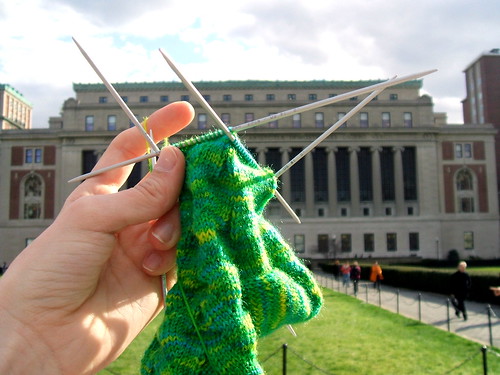
Knitting and the Butler Library

One sunny afternoon in April, I visited the Columbia University campus. It was gorgeous out, and I was knitting a sock ... I decided to remember the day's visit with a picture of the Butler Library with my project in the foreground.

Flickr

This is a test post from flickr, a fancy photo sharing thing.

Monday, July 7, 2008

Blogging and me

After watching Will Richardson's video, Weblogs in Education, I stopped and thought about the relevance of different blogs to my personal and professional lives, and student learning. I actually have kept two blogs over the years. One is very personal, and public posts are rare. The second blog (also kept on blogger), focuses primarily on my hobbies.

For student learning, blogs can be indispensable tools. As in Richardson's video, a class can create blogs to host book discussions --- and invite the author's input! I would love to collaborate with a history teacher: the students can create a blog of "current events" during a particular time in history. The students can each be a different character, and comment on one another's blog posts.

However, like all things, there is a dark side to blogging. There are safety and privacy issues to always consider. For the personal blog, I actually have several security measures in place. There is a friend's list. Only people I have "friended" can read those posts. Within those posts, however, is another layer of security, a "custom friends list". Not all my "friends" on this blogging site are people I know. The "custom" list is information that I only feel comfortable sharing with close friends who I actually know.

With the knitting blog, it's very public. However, I watch what I write on it. I keep as much personal information off it. No one needs to know where I keep my wool stash or where I live!

Children are very innocent, and the majority of children I have met are very trusting. While a blog in a fifth grade class sounds like a great idea, I worry that the kids might reveal too much of their private lives. Their surnames, their addresses... With blogging, as with everything else related to the Internet, Internet safety must always be taught.

However, blogging to connect with students in other countries, with authors of books, with movers and shakers in specific fields? That's awesome. This is the new way of journal-keeping, with comments from all over the world. To find bloggers with similar interests? Nifty! Students who feel that no one else has the same interest as them can find other bloggers with similar interests (a student interested in beekeeping can probably find quite a bit of beekeeping blogs, blogs about bees, blogs about first aid for bee stings).

Musings on information

I completed the pre-course reading assignments over a week ago, so I'm a bit rusty. Right now I have the other tab open, so I can re-read David Warlick's article, "How Has Information Changed?"

I believe that we are now living in an age of information overload. Though this is satisfying to my inner news-junkie (I can visit several different news websites - such as cnn.com, nytimes.com, and even the BBC every five minutes when at my desk job), it does mean that research can become overwhelming!

Research used to involve the card catalog (rifling through hundreds of cards), books, and a stack of index cards. While research is still like that for me (I work in a library department that has yet to be automated), today's K-12 students can use Google, their school library's website, blogs, even ebrary and Google books! Especially today, the old adage, "Don't believe everything you read," is important. How will students learn what is, and what is not, valuable, factual information?

The answer lies with us (and our other partners in crime, the classroom teachers). Evaluation of information is a critical skill for survival ... and to be heard in this world, one's message must be coherent, concise, and, to borrow from David Warlick, compelling.